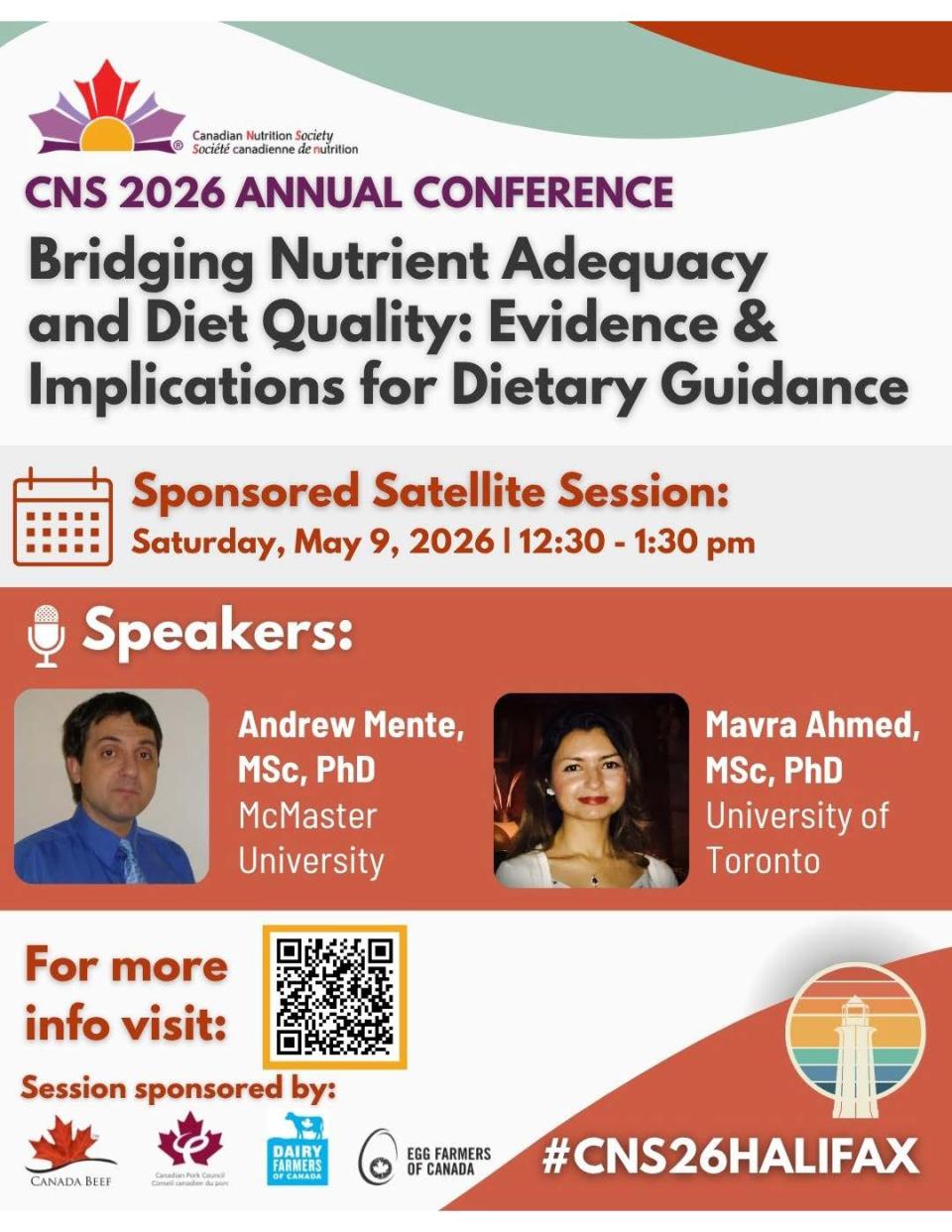

Bridging Nutrient Adequacy and Diet Quality: Evidence & Implications for Dietary Guidance

Webinar

Canada’s dietary landscape is rapidly evolving, shaped by shifting food choices, growing attention to excess nutrient intakes, and heightened interest in planetary health.  

During this session at the 2026 Canadian Nutrition Society (CNS) Annual Conference, Dr. Mavra Ahmed (University of Toronto) and Dr. Andrew Mente (McMaster University) examine the latest evidence on Canadian nutrient intakes across the lifespan, highlighting shortfalls in key nutrients such as iron, calcium, and vitamin D. The session also explores how diet quality and flexible dietary patterns, including those highlighted in the recent PURE study, support nutrient adequacy, cardiometabolic health, and longevity. Together, these insights can help inform evidence-based dietary guidance and clinical practice in Canada.

CNS 2026 Annual Conference : Bridging Nutrient Adequacy and Diet Quality: Evidence & Implications for Dietary Guidance

To watch this free presentation, access CNS recordings here.  

Note that this presentation has been made available and accessible at no cost to both CNS members and non-members thanks to a joint sponsorship between DFC, Canada Beef, Egg Farmers of Canada, and the Canadian Pork Council.  

By the end of the webinar, participants will:  

  1. Gain insight on nutrient intakes and status to identify micronutrient inadequacies in the Canadian population, with a focus on shortfall nutrients.  

  1. Explore how dietary patterns influence both nutrient adequacy and long-term outcomes, including cardiometabolic disease risk and mortality.  

  1. Understand the implications of findings on dietary guidance.

 
To watch the webinar
Click here
Speaker
Andrew Mente PhD, MA

ANDREW MENTE, PhD, MA

Associate Professor, Department of Health Research Methods, Evidence, and Impact (HEI), McMaster University
Scientist, Population Health Research Institute (PHRI)

Dr. Andrew Mente received his doctoral degree in Epidemiology from the University of Toronto. He completed post-doctoral training in cardiovascular epidemiology at McMaster University in Hamilton, Canada, and is currently an Associate Professor in Health Research Methods, Evidence, and Impact at the Population Health Research Institute, McMaster University. He has received a Research Fellowship from the Heart and Stroke Foundation of Canada, and a Research Early Career Award from Hamilton Health Sciences. 

Dr. Mente has studied the role of dietary sodium and cardiovascular diseases. His team conducted the largest ever epidemiologic study of the impact of sodium intake on blood pressure, cardiovascular disease risk, and mortality in the Prospective Urban Rural Epidemiology (PURE) study, a study of over 100,000 individuals from 18 low, middle and high income countries on 5 continents. Recently, Dr. Mente has co-led an investigation on the role of fats, carbohydrates, and dairy foods in cardiovascular disease in the PURE cohort. He also has conducted numerous large systematic reviews of diet and cardiovascular disease including saturated fat. He is currently co-leading nutrition work in the PURE study investigating the impact of individual foods on cardiovascular markers and cardiovascular disease events. He has published 85 papers and 2 Chapters.


Speaker
Mavra Ahmed, PhD

MAVRA AHMED, PhD

Research Associate, Department of Nutritional Sciences, University of Toronto

Dr. Mavra Ahmed is a Research Associate at the Department of Nutritional Sciences and Joannah and Brian Lawson Centre for Child Nutrition, University of Toronto. Mavra has experience in nutrition and food policy and clinical nutrition with strong expertise in research methods, with extensive collaborations with both private and public partners. 

Mavra obtained her PhD, specializing in characterization of dietary intakes of Canadian Armed Forces and evaluation of novel technologies for assessing diets. She also holds a CIHR Fellowship in the Strategic Training Program in Public Health Policy. Mavra has expertise in dietary assessments, including computing intakes of energy, nutrients and other dietary constituents using food composition tables and in the use of the NCI method and SAS macros for analyzing national nutrition survey data. 

Her current research focuses on exploring the use of machine learning and artificial intelligence in evaluating the Canadian food environment, specifically the impact of the nutritional value of foods on health outcomes and in relation to help guide Canadian nutrition policy development, implementation and evaluation and in order to help Canadian consumers eat healthy and manage chronic diseases. She is also spearheading a major research initiative on school nutrition research that aims to identify best practices in relation to the design, delivery, and measurement of school food programs.